Inicio Insights – The Barrier to Demo is Dead

Why trusted deployment, governance and operational confidence are becoming the real competitive barriers in regulated AI.

The core argument: It is now easy to build something that looks convincing. It is still hard to launch something that is trusted, governed and fit for use in a regulated environment.

Not long ago, if a prospective client saw a specialist AI product and said, “We think we could build that ourselves,” it usually meant a significant investment of time, money and technical resource.

Now, it may mean a week.

In truth, it may not even take that long.

DOWNLOAD THE FULL INSIGHT PAPER
    Blog – AI Affordability Assessments and Consumer Duty

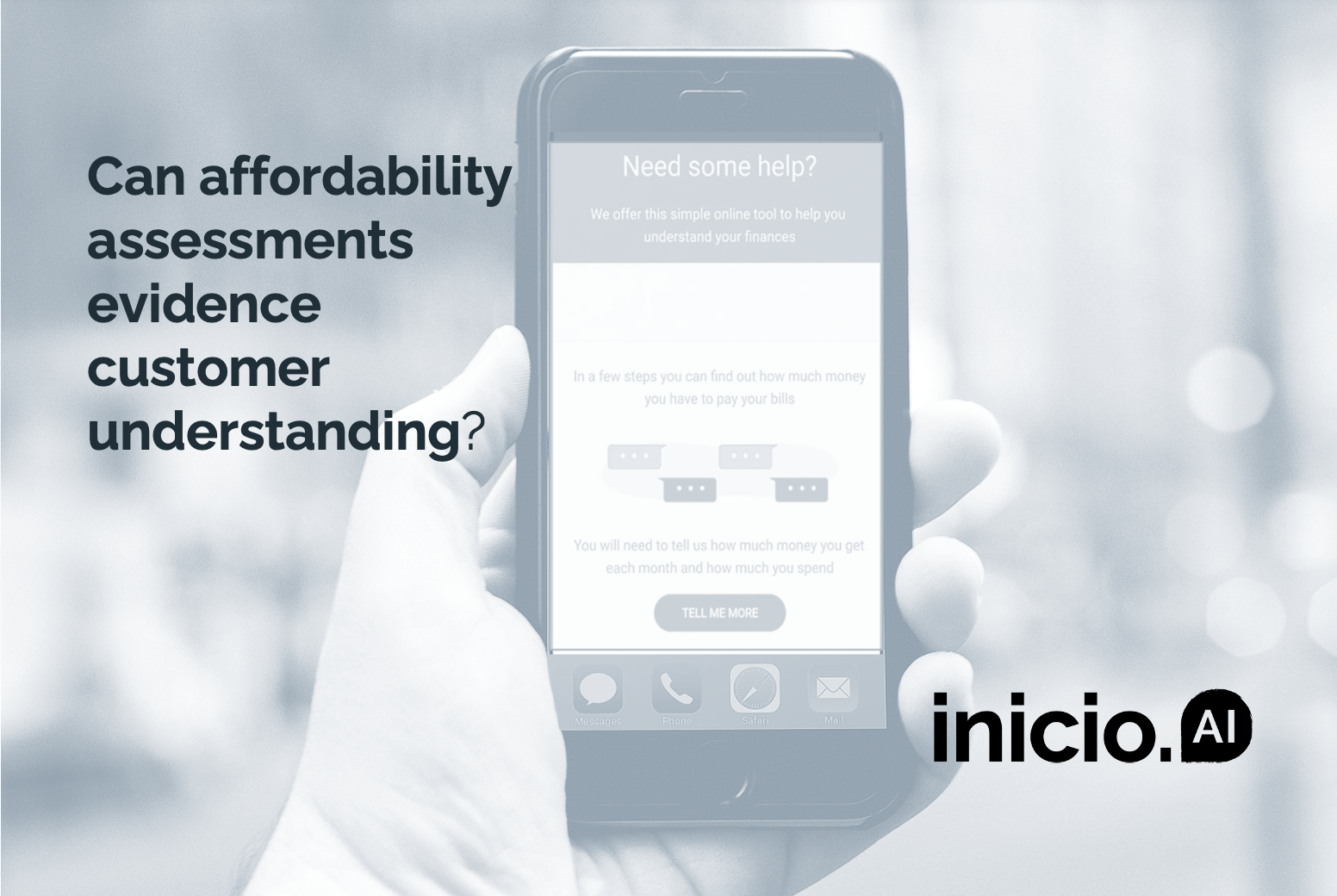
    The FCA has raised the bar on Consumer Duty. Discover how AI affordability assessments can help lenders evidence the Consumer Understanding outcome. 

    In March 2026, the Financial Conduct Authority published its review of the Consumer Understanding outcome under Consumer Duty. For lenders using AI affordability assessments, it makes for instructive reading, not because it introduces new rules, but because it describes, in practical terms, what good actually looks like, and where many firms are falling short.

    The shift: from communication to evidence

    The central message is clear. Firms are not being asked simply to provide information, they are expected to demonstrate that customers:

    • understand what they are being told
    • can act on it
    • and are supported at the right moments in their journey

    This is a meaningful shift. The FCA explicitly challenges reliance on:

    • the absence of complaints
    • sales outcomes
    • or assumptions that “clear wording” equals understanding

    Instead, firms are expected to build evidence-based, testable, and auditable approaches to communication, supported by management information, testing, and governance.

    Where firms are falling short

    The review identifies consistent patterns across firms:

    • Reactive rather than proactive approaches to vulnerability
    • Testing that is one-off, superficial, or poorly evidenced
    • Limited ability to show how insight leads to change
    • Governance that focuses on compliance metrics rather than comprehension

    These are not edge cases. They are recurring themes and at the same time, the FCA is equally clear on what good looks like.

    What good looks like in practice

    Firms performing well are doing a number of things differently:

    • Identifying vulnerability early and at key moments of stress
    • Capturing accessibility needs once and applying them consistently
    • Testing communications with real customers, before and after changes
    • Using tools and journeys that actively support understanding
    • Producing management information that evidences comprehension, not just activity

    In one example, a firm set an internal benchmark that at least 80% of customers must correctly recall key information and iterated its communications until that standard was met. This is the level of rigour the FCA is pointing towards.

    Why this matters most in affordability

    For lenders, these expectations land most clearly in affordability and income & expenditure assessments. These are the moments where:

    • customers disclose sensitive financial information
    • vulnerability is most likely to surface
    • understanding is critical to outcomes

    And they are also the moments that will be most heavily scrutinised if something goes wrong. The question is no longer “Did we ask the right questions?” it’s “Can we evidence that the customer understood, and that we responded appropriately?”

    A structural challenge for many firms

    Traditional affordability processes were not designed with this standard in mind. They are often:

    • agent-led and variable
    • difficult to evidence consistently
    • reliant on interpretation rather than structure
    • weak in producing auditable insight

    Even where technology is introduced, many solutions still sit outside the regulatory perimeter, acting as tools rather than accountable processes. That distinction is becoming more important. For firms looking to meet their AI affordability assessments Consumer Duty obligations, that distinction is now critical.

    How AI affordability assessments embed regulation into the process

    In a market where AI affordability assessments and Consumer Duty compliance are scrutinised, Inicio operates within the regulatory perimeter, not outside it. Inicio is an FCA-regulated provider of affordability assessments, using conversational AI to capture income, expenditure and vulnerability in a structured, consistent and auditable way. This changes the role of technology. Rather than supporting the process, it becomes the process, one that is:

    • consistent across every interaction
    • adaptable in real time to customer responses
    • designed to support understanding, not just data capture
    • capable of producing structured, timestamped evidence of customer outcomes

    Every interaction generates management information that can be fed directly into governance, aligned with the FCA’s expectation that firms move towards comprehension-driven insight, not just compliance reporting.

    From aspiration to evidence

    The FCA’s review is not a warning shot. It is a roadmap and sets out clearly:

    • what firms should be doing
    • how they should be measuring it
    • and the level of evidence expected

    For lenders, this raises a fundamental question: Is your affordability process designed to meet that standard or to evidence it? Because increasingly, those are not the same thing.

    The direction of travel

    Consumer Duty is pushing the industry beyond communication and into accountability.

    Understanding is no longer assumed, it must be demonstrated and that requires processes that are structured, testable and capable of standing up to scrutiny.

    Final thought

    Affordability assessments are among the highest-stakes interactions in the customer journey, they are where:

    • vulnerability must be identified
    • understanding must be clear
    • and decisions must be defensible

    As expectations continue to rise, the firms that succeed will not be those that say the right things but those that can prove them.


    If you’d like to explore how Inicio supports firms in evidencing the Consumer Understanding outcome, we’d be happy to continue the conversation.


    Blog -Setting a New Standard in Motor Finance

    Finclusion Introduces Innovative Assessments at the Start of the Customer Journey

    The UK motor finance sector is undergoing one of the most significant periods of reflection and change in its history. For lenders, the question of how AI affordability assessments can support responsible lending in motor finance has never been more pressing.

    In recent years, questions around affordability, transparency, and customer outcomes have moved sharply into focus. Large-scale redress schemes and increased regulatory scrutiny have highlighted the need for lenders to demonstrate not only compliance, but genuine understanding of a customer’s ability to sustain borrowing.

    This moment is not just about addressing the past. It is about shaping the future.

    Against this backdrop, a new generation of lenders is emerging, organisations building their models around responsible lending from the outset, rather than adapting retrospectively. Finclusion is one such lender, using AI affordability assessments in motor finance.

    Designing affordability in from day one

    As a new entrant to the motor finance market, Finclusion has made a deliberate decision to embed affordability assessments at the very start of the customer journey, working in partnership with Inicio AI.

    This marks a significant departure from traditional approaches, where affordability assessments have often relied heavily on only indirect data sources such as credit files, scorecards, and income estimates.

    Finclusion is introducing conversational affordability assessments creating an additional transparent and structured way to understand a customer’s financial position before lending decisions are finalised.

    This allows affordability to be assessed not simply as a compliance checkpoint, but as a meaningful part of responsible lending.

    Moving affordability upstream

    Inicio’s conversational AI platform has historically been deployed to support customers during periods of financial difficulty, helping lenders engage sensitively, understand individual circumstances, and agree sustainable outcomes.

    Finclusion’s implementation represents a new and important evolution.

    By introducing Inicio’s affordability solution at origination, Finclusion is proactively building deeper financial understanding into the lending process itself. 

    This shift moves affordability from a reactive exercise to a proactive foundation.

    It reflects a belief that better conversations at the start of the journey can lead to better outcomes throughout the life of the agreement.

    Setting a new tone for motor finance

    As regulatory expectations continue to evolve, AI affordability assessments in motor finance are becoming a critical tool for lenders needing to demonstrate not only that affordability has been assessed, but that it has been assessed appropriately.

    Finclusion’s approach reflects a forward-looking perspective, recognising that responsible lending is not just about meeting regulatory requirements, but about building sustainable relationships with customers.

    By embedding conversational affordability from the outset, Finclusion is helping to establish a model built on clarity, understanding, and transparency.

    A shared commitment to better outcomes

    Inicio is proud to support Finclusion in this important step.

    This partnership reflects a shared commitment to improving how affordability is understood and assessed, ensuring customers are supported appropriately from the very beginning of their journey.

    As the motor finance sector continues to evolve, initiatives like this demonstrate how technology and lender intent can work together to set new standards for responsible lending.

    We’d be happy to continue the coversation. 

    Blog – Customer capacity fluctuates daily – systems rarely do

    Blog – Customer capacity fluctuates daily – systems rarely do.

    By Amani Darr

    In affordability support, intent is rarely the issue. Most organisations genuinely want to do the right thing for customers facing financial pressure or challenging life circumstances. What’s often underestimated is how much the format of support determines whether customers engage at all.

    Having worked in and around the vulnerability and affordability space for several years, one thing has become increasingly clear – customers don’t delay seeking help because solutions don’t exist. They delay because, in that moment, the way support is offered doesn’t feel safe or manageable.

    The first barrier is emotional, not structural

    By 2026, digital engagement is no longer an alternative channel – it’s the norm. But for customers with additional support needs, this shift isn’t just about convenience – it’s about control, dignity, and timing.

    Research from StepChange Debt Charity shows that 92% of customers wish they’d sought debt advice sooner (2023 Client Insight Report). The reasons they didn’t are well documented – shame, stigma, fear of judgement, and uncertainty about what would happen next.

    For many, the challenge isn’t knowing they need support – it’s finding a way to engage that feels manageable on that particular day.

    Capacity fluctuates. One day someone may feel able to speak to a person. On another, digital engagement without the pressure of real-time human interaction might feel like the only manageable option. And on particularly difficult days, even small decisions can feel overwhelming. In those moments the ability to pause, step away, and return later isn’t a convenience – it’s the difference between engaging and disengaging entirely.

    This is why our solution was designed the way it was – not to remove human support, but to create safer and more equitable first steps into engagement. Omni-channel support isn’t about offering everything to everyone. It’s about recognising that an individual with additional support needs’ resource fluctuates – and that forcing engagement through a single route can unintentionally raise barriers.

    Vulnerability is dynamic, our systems often aren’t

    One of the most persistent operational challenges I’ve seen is how vulnerability is treated once identified.

    Too often it becomes a static flag – applied once, recorded, relied upon indefinitely or even forgotten altogether. Vulnerability is not a segment, it’s a spectrum. People move in and out of it depending on life events, stress, financial shocks, and confidence. Someone may cope well one week and struggle the next. Affordability pressures, mental load, and decision-making capacity can vary day to day.

    When organisations rely solely on fixed classifications, they risk missing this nuance. Support models built around consistency can unintentionally fail people whose lived experience is anything but consistent.

    The wider issue is visibility. If organisations cannot see how customers actually experience and move through affordability journeys – the hesitation, the abandoned steps, the partial disclosures, it becomes very difficult to design meaningfully better support. Without visibility of friction, improvement to customer outcomes is largely guesswork.

    For example, a customer may abandon an affordability form three times before completing it. That pattern isn’t non-compliance – it’s an early-warning sign.

    We can’t improve what we won’t see.

    Where Conversational AI can genuinely help

    AI is often discussed in extremes, either as a replacement for human support or as a silver bullet for vulnerability. Neither is strictly true – used responsibly its value lies elsewhere.

    Conversational AI platforms can create space for customers to engage earlier and more comfortably, capturing context in their own words and language. Rather than forcing disclosure into a single high-pressure interaction, engagement can unfold gradually.

    With the Inicio solution, it means customers can progress through affordability conversations in a way that feels manageable to them – pausing, returning, and reviewing when needed.

    Importantly, AI tools don’t need to determine whether someone is vulnerable. Instead, they can supplement existing knowledge by capturing signals that may indicate whether an individual has additional support needs – hesitation, repeated uncertainty, or difficulty progressing – and preserving that information in a way so that organisations and specialist teams can respond fairly and appropriately.

    From auditability to empathy

    One often overlooked benefit of Conversational AI platforms is the audit trail they create. Not just of actions taken, but of conversations held.

    Reviewing what a customer has said, how they engage, and where friction occurred provides organisations with far richer insight than a binary flag ever could. It allows trained teams to spot patterns, consider context, and apply judgement more effectively.

    When organisations can access this fuller picture of engagement – not just outcomes, but the journey itself – it creates a different type of internal conversation. The focus becomes less about customer “non-compliance” and more about structural friction. Instead of asking why someone didn’t engage, teams can begin asking what in the experience made engagement harder than it needed to be.

    Whilst exceedingly important, auditability isn’t just about compliance. It’s a vital bridge between digital engagement and human empathy.

    From reactive contact to proactive engagement

    As conversational technologies evolve, there is an opportunity to move beyond static vulnerability markers towards more responsive, context-driven support models.

    This doesn’t mean the automation of care, or necessarily the reduction of human involvement. It means increasing visibility so organisations can adapt to customers whose needs may shift from one day, or even week, to the next.

    Affordability support has never been limited by intent, it has often been limited by format. If we recognise that vulnerability is dynamic, then our systems must be capable of responding dynamically too.

    Designing engagement around how customers actually behave – rather than how we expect them to behave – enables earlier intervention, reduces avoidable harm, and creates fairer, more sustainable outcomes for both customers and organisations.

    Tools like the Inicio solution form part of that shift – not as a replacement for human care, but as infrastructure that makes better care possible.

    Amani Darr - Head of Customer Success

    Blog – Energy Debt Landscape is Resetting

    Blog – The Energy Debt Landscape is Resetting – Are Suppliers Ready?

    By Caroline Walton

    The UK energy sector is entering a pivotal moment. After years of rising arrears, mounting affordability pressures, and stretched support mechanisms, regulators are signalling something unmistakable:

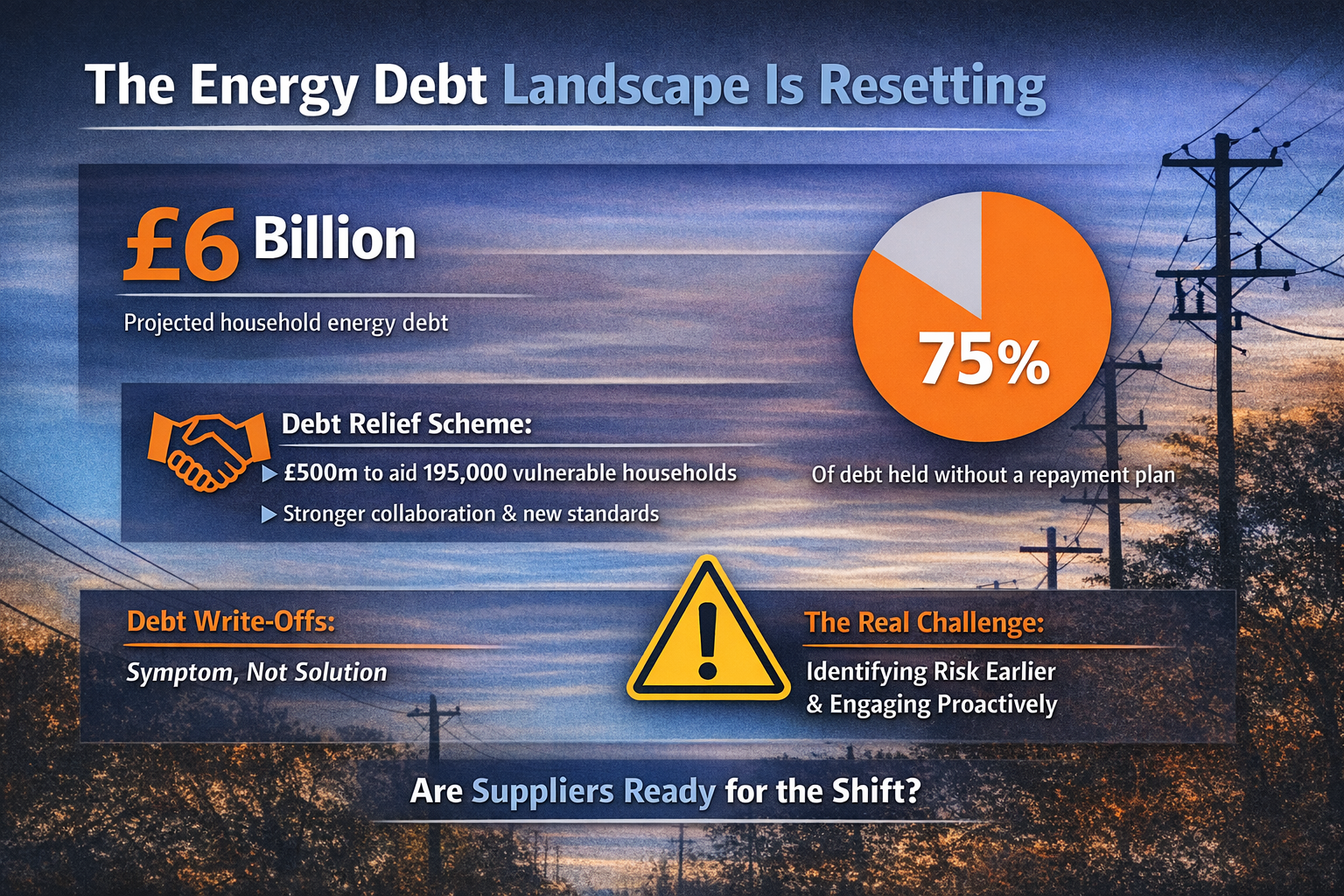
    • Household energy debt is projected to reach £6 billion, with approximately 75% of debt held by customers without a repayment plan in place[1]
    • This is not simply a collections challenge. It is a systemic risk to customer outcomes, supplier operations, and market stability, and Ofgem is responding accordingly.
    • Incremental change is no longer enough. Structural reform is underway.


    [1] Ofgem – Working with Debt Advice Providers to Support Consumers in Energy Debt | LinkedIn

    A Shift from Guidance to Intervention

    The proposed Debt Relief Scheme marks a significant evolution in regulatory posture, from encouraging good practice to actively reshaping how debt is managed.


    The scheme aims to write off around £500 million of debt for roughly 195,000 vulnerable households, targeting those who accumulated arrears during the energy crisis. [1]

    But this intervention is not happening in isolation. Alongside financial relief, Ofgem is pushing for:

    • Stronger collaboration between suppliers and FCA-regulated debt advice providers
    • Clearer customer journey standards
    • Improved communication and record-keeping
    • Greater consistency in repayment offers
    • Enhanced referral pathways for vulnerable consumers [1]

    Taken together, this signals something far bigger than a one-off scheme. It signals a reset in expectations.

    The Scale of the Challenge is Growing

    Energy debt has already reached record levels, standing at £4.15 billion, with nearly 2 million households in debt lacking a repayment arrangement. [2]

    In response, Citizens Advice is launching the Consumer Energy Debt Advice (CEDA) service in partnership with major debt charities, offering holistic support designed to help households regain financial stability. [2]

    Traditional supplier-led debt management is no longer sufficient on its own.

    A more coordinated ecosystem is emerging, one that blends suppliers, advisers, regulators, and data sharing frameworks. For suppliers, this will require a step change in operational maturity.

    [2] Citizens Advice launching a new debt advice service for energy consumers in England and Wales later…

    Debt Relief Is Necessary - But Won't Solve the Strucutural Problem

    Ofgem is clear about the stakes. Without intervention, unsustainable debt risks increasing prices for all consumers and destabilising the market. [3]

    Yet the regulator also recognises a critical limitation in the current system: debt allowances within the price cap do not directly translate into customer debt write-offs, meaning indebted households may continue to face recovery action despite the socialised cost of bad debt. [3]

    The proposed scheme therefore seeks to:

    • Reduce domestic debt and arrears
    • Improve supplier-customer relationships
    • Clear historical crisis-era debt
    • Support more sustainable repayment behaviours [3]

    However, writing off debt addresses the symptom, not the root cause.

    The deeper challenge remains: How can suppliers identify risk earlier, engage customers more effectively, and prevent debt from escalating in the first place?

    [3] Resetting the energy debt landscape: the case for a debt relief scheme

    A New Operating Environment for Suppliers

    The direction of travel is unmistakable. Regulators want vulnerable consumers placed firmly at the centre of supplier culture, supported by compassionate, consistent, and affordable solutions. [1]

    They are also signalling greater scrutiny of outcomes, not just processes. This has several strategic implications.

    Reactive models will struggle – Waiting until arrears accumulate is no longer viable in a market where regulators expect earlier intervention.

    Collaboration will become operational – Working seamlessly with debt advice providers will move from “best practice” to baseline expectation.

    Data capability will differentiate leaders – Suppliers that can build a clearer, real-time view of affordability and vulnerability will be better positioned to act before debt becomes unmanageable.

    Customer engagement must evolve – Disconnected customers are harder and more expensive to support later.

    Early, intelligent engagement is rapidly becoming a commercial as well as regulatory imperative.

    The Opportunity Behind the Obligation

    While the regulatory tone is firm, this reset also presents an opportunity. Suppliers that modernise their approach to debt management can:

    • Strengthen customer trust
    • Reduce long-term servicing costs
    • Improve regulatory alignment
    • Enhance resilience against future economic shocks

    Most importantly, they can move from debt recovery to debt prevention — a far more sustainable model.

    How Inicio Supports Suppliers Through This Shift

    At Inicio, we support suppliers navigating complex customer affordability and vulnerability challenges by turning regulatory expectation into practical, scalable action.[4]

    As an FCA-regulated firm, Inicio provides conversational AI technology designed to help organisations understand a customer’s true circumstances earlier and with greater confidence.

    Developed and shaped by extensive research with individuals experiencing financial difficulty, Inicio’s conversational AI is purpose-built for affordability and vulnerability assessment. It reflects years of real financial support conversations, enabling more sensitive, structured, and effective engagement than traditional scripted approaches or generic AI tools.

    Traditional assessment models often rely on lengthy, sensitive conversations that can be difficult for both agents and customers to navigate. By enabling more natural, intelligent interactions, Inicio helps uncover signs of financial stress and vulnerability sooner, allowing suppliers to move more quickly from identification to support.

    The result is not simply faster assessments, but better outcomes reducing operational friction while helping customers access the right solutions before debt becomes unmanageable.

    [4] Inicio Case Studies


    Blog – The commercial case for robust income & expenditure assessments

    Blog – The commercial case for robust income & expenditure assessments

    By Caroline Walton

    For years, affordability checks were seen primarily as a regulatory obligation. But the evidence now shows something more powerful: robust income and expenditure (I&E) assessments don’t just protect customers — they also deliver measurable commercial benefits.

    Firms in lending, debt purchase, consolidation and collections are facing multiple pressures: rising debt levels, workforce shortages, and increasing regulatory expectations. The FCA’s Borrowers in Financial Difficulty Review and Policy Statement 24/2 both highlight the need for full affordability checks and sustainable repayment plans. That’s a compliance imperative — but it’s also a commercial opportunity.

    Where the benefits lie

    Workforce efficiencyCompleting I&Es is demanding, time-consuming work. In many firms it falls to entry-level agents, creating recruitment and retention challenges. But by using guided digital tools:

    • Agent time on I&Es can be reduced by up to 90%.
    • Training time can fall by 80%, with technology prompting agents through complex cases.
    • Customers are increasingly willing to self-serve, with around 30% switching from agent-led to digital assessments.

    Improved repayment values – Strong affordability checks lead to stronger outcomes:

    • Repayment values improved by 60% on average.
    • Sustainable repayment plans are up by around 5%, reducing rework and default.
    • Identifying unclaimed benefits can boost customer resilience, with some firms finding an extra £350 or more per month for customers.

    Regulatory alignment and trustThe FCA expects I&Es to be reliable, auditable and shareable. With the right systems in place:

    • Every interaction can be quality checked with a full audit trail.
    • Assessments can be passported, helping customers share data with other creditors.
    • Messaging and journeys can be A/B tested to evidence which approach delivers the best customer outcomes.

    The bottom line

    Robust affordability assessments are no longer just about compliance. They unlock efficiency for agents, improve repayment performance, and build customer trust. Firms that invest in the right solutions will not only meet the regulator’s expectations — they will also strengthen their commercial position.

    At Inicio we help firms realise these benefits every day. Our affordability solution is consistent, configurable and fully auditable. It reduces agent workload, increases digital uptake, and provides MI that proves effectiveness. In short: a regulatory must-have that delivers clear commercial returns. Could your firm benefit?

    Why not speak to us today.