
Blog – The Energy Debt Landscape is Resetting – Are Suppliers Ready?
By Caroline Walton
The UK energy sector is entering a pivotal moment. After years of rising arrears, mounting affordability pressures, and stretched support mechanisms, regulators are signalling something unmistakable:
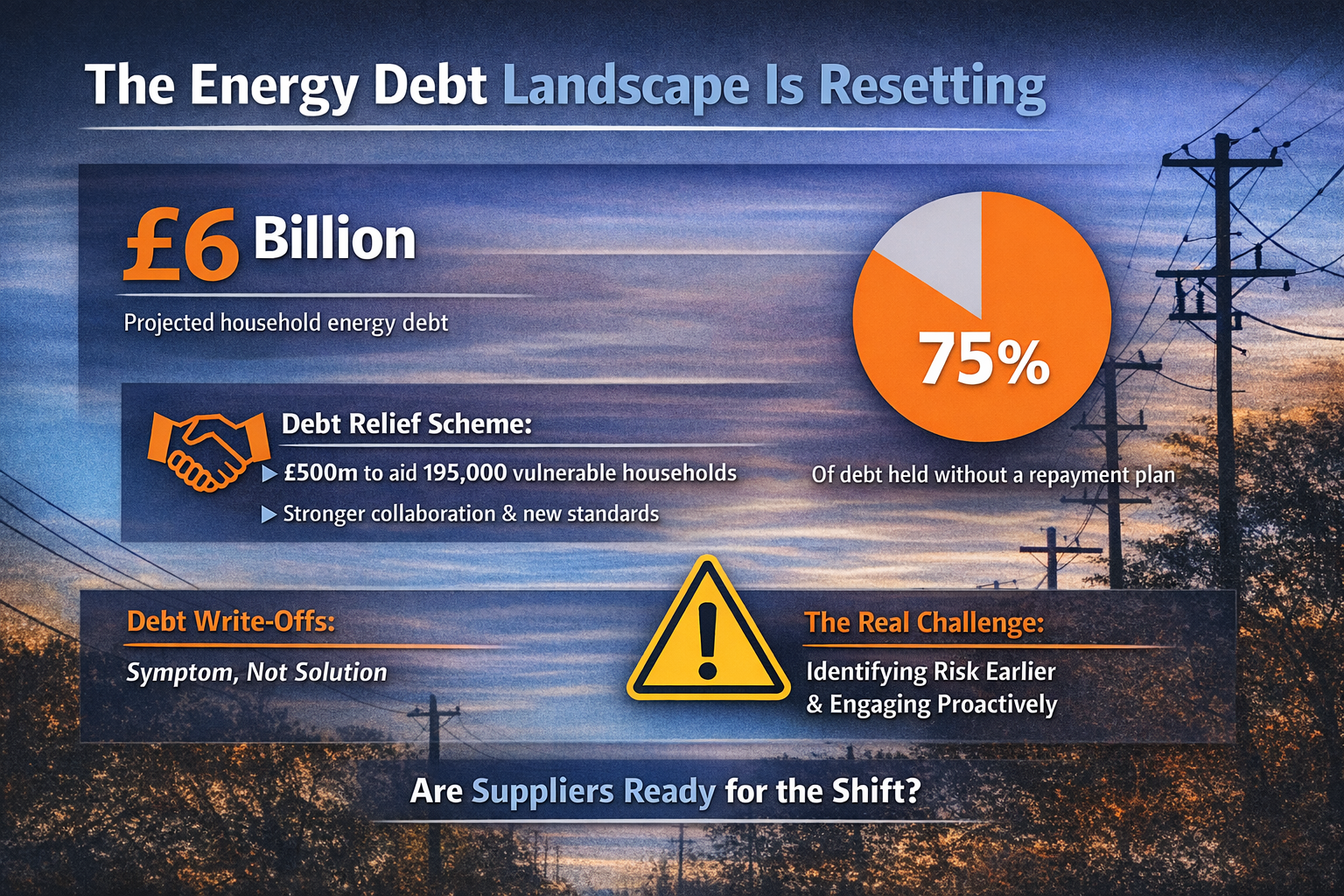
- Household energy debt is projected to reach £6 billion, with approximately 75% of debt held by customers without a repayment plan in place. [1]
- This is not simply a collections challenge. It is a systemic risk to customer outcomes, supplier operations, and market stability, and Ofgem is responding accordingly.
- Incremental change is no longer enough. Structural reform is underway.
[1] Ofgem – Working with Debt Advice Providers to Support Consumers in Energy Debt | LinkedIn
A Shift from Guidance to Intervention
The proposed Debt Relief Scheme marks a significant evolution in regulatory posture, from encouraging good practice to actively reshaping how debt is managed.
The scheme aims to write off around £500 million of debt for roughly 195,000 vulnerable households, targeting those who accumulated arrears during the energy crisis. [1]
But this intervention is not happening in isolation. Alongside financial relief, Ofgem is pushing for:
- Stronger collaboration between suppliers and FCA-regulated debt advice providers
- Clearer customer journey standards
- Improved communication and record-keeping
- Greater consistency in repayment offers
- Enhanced referral pathways for vulnerable consumers [1]
Taken together, this signals something far bigger than a one-off scheme. It signals a reset in expectations.
The Scale of the Challenge is Growing
Energy debt has already reached record levels, standing at £4.15 billion, with nearly 2 million households in debt lacking a repayment arrangement. [2]
In response, Citizens Advice is launching the Consumer Energy Debt Advice (CEDA) service in partnership with major debt charities, offering holistic support designed to help households regain financial stability. [2]
Traditional supplier-led debt management is no longer sufficient on its own.
A more coordinated ecosystem is emerging, one that blends suppliers, advisers, regulators, and data sharing frameworks. For suppliers, this will require a step change in operational maturity.
[2] Citizens Advice launching a new debt advice service for energy consumers in England and Wales later…
Debt Relief Is Necessary - But Won't Solve the Strucutural Problem
Ofgem is clear about the stakes. Without intervention, unsustainable debt risks increasing prices for all consumers and destabilising the market. [3]
Yet the regulator also recognises a critical limitation in the current system: debt allowances within the price cap do not directly translate into customer debt write-offs, meaning indebted households may continue to face recovery action despite the socialised cost of bad debt. [3]
The proposed scheme therefore seeks to:
- Reduce domestic debt and arrears
- Improve supplier-customer relationships
- Clear historical crisis-era debt
- Support more sustainable repayment behaviours [3]
However, writing off debt addresses the symptom, not the root cause.
The deeper challenge remains: How can suppliers identify risk earlier, engage customers more effectively, and prevent debt from escalating in the first place?
[3] Resetting the energy debt landscape: the case for a debt relief scheme
A New Operating Environment for Suppliers
The direction of travel is unmistakable. Regulators want vulnerable consumers placed firmly at the centre of supplier culture, supported by compassionate, consistent, and affordable solutions. [1]
They are also signalling greater scrutiny of outcomes, not just processes. This has several strategic implications.
Reactive models will struggle – Waiting until arrears accumulate is no longer viable in a market where regulators expect earlier intervention.
Collaboration will become operational – Working seamlessly with debt advice providers will move from “best practice” to baseline expectation.
Data capability will differentiate leaders – Suppliers that can build a clearer, real-time view of affordability and vulnerability will be better positioned to act before debt becomes unmanageable.
Customer engagement must evolve – Disconnected customers are harder and more expensive to support later.
Early, intelligent engagement is rapidly becoming a commercial as well as regulatory imperative.
The Opportunity Behind the Obligation
While the regulatory tone is firm, this reset also presents an opportunity. Suppliers that modernise their approach to debt management can:
- Strengthen customer trust
- Reduce long-term servicing costs
- Improve regulatory alignment
- Enhance resilience against future economic shocks
Most importantly, they can move from debt recovery to debt prevention — a far more sustainable model.
How Inicio Supports Suppliers Through This Shift
At Inicio, we support suppliers navigating complex customer affordability and vulnerability challenges by turning regulatory expectation into practical, scalable action.[4]
As an FCA-regulated firm, Inicio provides conversational AI technology designed to help organisations understand a customer’s true circumstances earlier and with greater confidence.
Developed and shaped by extensive research with individuals experiencing financial difficulty, Inicio’s conversational AI is purpose-built for affordability and vulnerability assessment. It reflects years of real financial support conversations, enabling more sensitive, structured, and effective engagement than traditional scripted approaches or generic AI tools.
Traditional assessment models often rely on lengthy, sensitive conversations that can be difficult for both agents and customers to navigate. By enabling more natural, intelligent interactions, Inicio helps uncover signs of financial stress and vulnerability sooner, allowing suppliers to move more quickly from identification to support.
The result is not simply faster assessments, but better outcomes reducing operational friction while helping customers access the right solutions before debt becomes unmanageable.
